 نیما پورنبی
When people think about plastic shopping bags, most of them only notice the final product: a bag used every day in supermarkets, grocery stores, fruit shops, and many other businesses. However, behind this seemingly simple product lies a complete industrial process involving engineering expertise, careful raw material selection, precise machine settings, and strict quality control. Each of these factors directly affects the final bag’s strength, appearance, and performance.
The plastic bag manufacturing process is not limited to melting plastic and turning it into film. The type of polyethylene used, the percentage of additives, the quality of raw materials, the extruder temperature, the cooling process, cutting, sealing, and even packaging all play an important role in determining the final product quality. That is why two bags that look almost identical may differ significantly in strength, flexibility, load-bearing capacity, and print quality.
In this article, we will examine the HDPE plastic bag manufacturing process from start to finish. First, we will look at the raw materials used, then explain each production stage step by step, introduce the main machines involved, and finally discuss the factors that affect bag quality and the difference between HDPE bags and nylon bags. If you are planning to buy plastic bags, set up a production line, or simply gain a deeper understanding of this product, this guide will give you a complete overview of the manufacturing process.
HDPE plastic bag manufacturing is an industrial process in which high-density polyethylene (HDPE) granules are melted inside an extruder and converted into a thin plastic film. After cooling, the film is cut into the required dimensions, sealed, and finally shaped with handles to produce ready-to-use plastic bags.
Although this process may seem simple at first glance, the final quality of the bag depends on several factors, including the type of raw material, additive ratio, extruder temperature settings, production speed, die quality, cooling system, and the accuracy of cutting and sealing operations. Any change in these parameters can affect the bag’s strength, flexibility, appearance, printability, and load capacity.
In general, the plastic bag production process can be summarized in the following main stages:
In the following sections, we will examine each of these stages in detail so you can better understand how HDPE plastic bags are produced, which equipment is used, and what factors influence final product quality.
In summary, HDPE plastic bag manufacturing includes selecting raw materials, melting polyethylene granules in an extruder, producing plastic film, cooling, cutting, sealing, handle punching, and packaging the final product.
The final quality of a plastic bag depends on raw material selection even before it depends on machines or production methods. The type of polymer, the amount of additives used, the quality of the masterbatch, and even the ratio of recycled material all directly affect the bag’s strength, flexibility, thickness, appearance, printability, and load-bearing performance.
That is why manufacturers use different material combinations depending on the type of product they want to produce. For example, the formulation of a retail shopping bag is not necessarily the same as that of a heavy-duty carrying bag or an industrial packaging bag.
In general, the raw materials used in HDPE plastic bag production can be divided into four main groups:
Let us look at the role of each material.
Raw Materials for Grade A Nylex (Polyethylene) Bags
The main raw material used in plastic bag manufacturing is high-density polyethylene (HDPE). Due to its dense molecular structure, this polymer offers high tensile strength and makes it possible to produce thin yet durable plastic films.
For this reason, most shopping bags, vest carrier bags, die-cut handle bags, and many packaging bags are made from HDPE granules.
The main advantages of HDPE include:
However, not all HDPE grades are the same. Performance varies depending on the manufacturer, resin grade, and melt flow index (MFI).
Masterbatch is a concentrated polymer compound added to raw materials to create color or improve certain technical properties.
For example, if a bag needs to be produced in black, white, red, or green, the required color is added through masterbatch.
In addition to coloring, some masterbatches are used for other purposes, such as:
The type and percentage of masterbatch must be selected carefully, because excessive use may negatively affect the bag’s strength or appearance.
In many production lines, manufacturers use various additives in addition to polyethylene and masterbatch to improve the properties of the final product according to its intended application.
Some of the most common additives include:
The amount of each additive depends on the product type, production conditions, and final use.
In some products, part of the raw material can be supplied through recycled granules. Using recycled material helps reduce production costs and save virgin resources. However, the quality of recycled granules has a direct impact on final product quality.
For products where strength, appearance, and print quality are critical, a higher percentage of virgin material is usually used. In contrast, for certain industrial products or less sensitive applications, a specific percentage of recycled material may be included in the formulation.
It is important to note that using recycled materials does not necessarily mean producing a low-quality product. Final quality depends on the source of the recycled material, the recycling process, and the blending ratio with virgin resin.
Choosing suitable raw materials is not limited to selecting the polymer type alone. Manufacturers usually consider factors such as:
As a result, two plastic bags with a nearly identical appearance may differ significantly in raw material composition, durability, and overall performance.
The raw materials used in HDPE plastic bag manufacturing typically include HDPE, masterbatch, polymer additives, and in some cases recycled granules. Selecting the right materials plays a decisive role in bag strength, print quality, thickness, flexibility, and service life.
The plastic bag manufacturing process is a sequence of engineering operations that begins with raw material selection and ends with a ready-to-use plastic bag. Although machinery type and raw material formulation may differ from one factory to another, the overall production principles are largely the same.
Below, we review each production stage in order.
The first stage in plastic bag production is selecting the appropriate raw materials. At this stage, materials are chosen based on the product type, final application, required thickness, and expected strength.
The main materials usually include HDPE, masterbatch, polymer additives, and if needed, a certain percentage of recycled material.
Before entering the extruder, all components are weighed according to the selected formulation. Accuracy at this stage is very important, because even a small variation in material ratio can affect the final product quality.
After preparation, the raw materials are fed into a mixer so they can be blended uniformly.
The purpose of this stage is to achieve an even distribution of color, additives, and all other components throughout the entire material batch. If mixing is not done correctly, the final product may suffer from problems such as color inconsistency, reduced strength, or weak spots in the plastic film.
In many modern production lines, this process is automated using dosing systems to ensure precise material ratios.
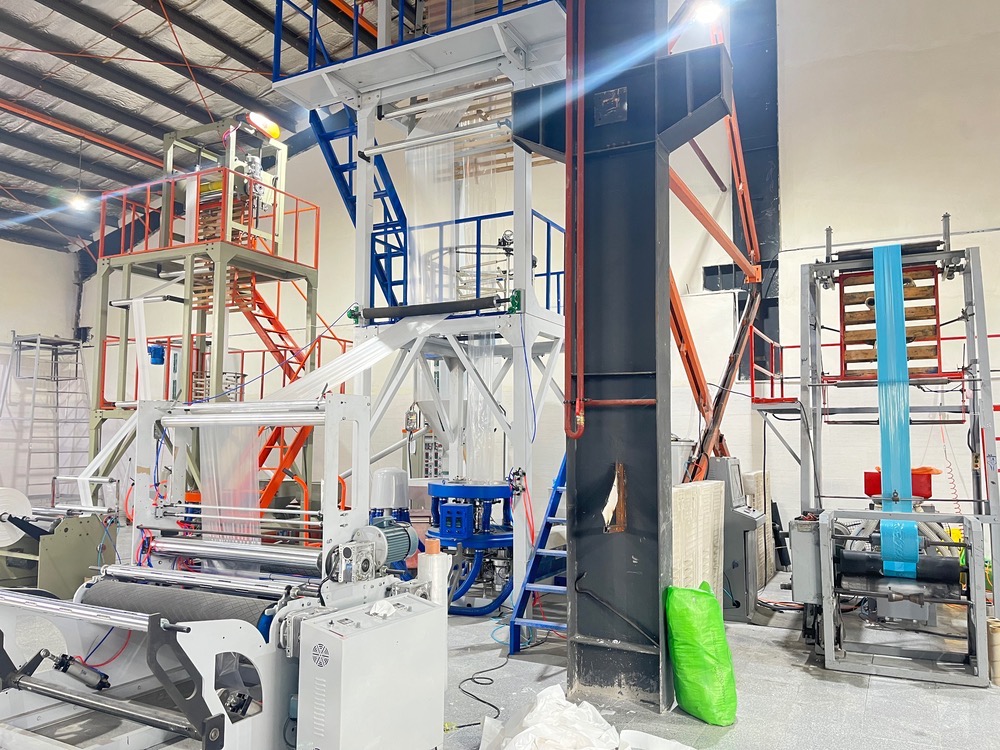
The mixed materials enter the extruder through a hopper. The extruder can be considered the heart of the plastic bag production line.
Inside the machine, a rotating screw pushes the materials forward while heating elements gradually raise the temperature until the polymer melts and becomes a uniform molten mass.
Precise temperature control is essential at this stage. If the temperature is too low, the materials may not melt properly. If it is too high, the polymer structure may degrade, resulting in lower product quality.
After melting, the polymer exits through a die and compressed air is blown into it to form a large plastic bubble. This process, known as blown film extrusion, is the most common method of manufacturing plastic bags worldwide.
At this stage, film thickness, product width, and uniformity are controlled by adjusting air pressure, take-up speed, and melt output.
Any fluctuation in these parameters can lead to thickness variation, film waviness, or reduced product quality.
Once the plastic bubble is formed, cool air is directed around it to reduce the film temperature and stabilize the polymer structure.
The quality of the cooling system has a direct impact on film clarity, strength, thickness uniformity, and the final appearance of the bag.
After cooling, the film passes through a set of rollers and is directed toward the winding unit.
The produced film is collected in the form of large rolls. Then, using slitting machines, these rolls are cut to the width required for the final product.
The cutting dimensions are determined based on the bag type, customer order, and product application.
Accuracy at this stage ensures that all produced bags have consistent dimensions and a good visual appearance.
At this stage, the slit rolls enter the sealing machine.
Using heat, the machine seals the bottom of the bag and then creates the required handle shape.
Handle types may vary, such as:
The quality of the sealing area is one of the most important factors determining the bag’s strength during use.
The final stage is inspection of the finished product.
At this stage, manufacturers usually check:
Once the product passes quality control, the bags are counted, packed, and prepared for delivery to the warehouse or customer.
The HDPE plastic bag manufacturing process includes eight main stages:
The final quality of a plastic bag depends on more than one factor. It is the result of proper coordination between raw materials, production parameters, machinery performance, and quality control procedures.
Below are the most important factors affecting bag quality.
Raw materials are the most important factor in determining bag quality. Using high-quality HDPE, standard masterbatch, and suitable additives improves product strength, uniformity, and durability.
On the other hand, excessive use of poor-quality recycled material or low-grade granules can reduce strength and increase the risk of tearing or puncturing.
Bag quality does not depend only on the type of raw materials, but also on their mixing ratio. Each product requires a different formulation depending on its application.
For example, a bag intended for carrying heavy goods may require a different formulation than a bag used in clothing stores. Selecting the right ratio of virgin material, additives, and other components plays a major role in final product performance.
One of the most important quality indicators is uniform film thickness. If thickness is not consistent across the film, thinner areas will tear more easily under stress.
Professional manufacturers maintain uniform thickness across the entire film width through precise extruder settings and process control.
Proper extruder temperature settings, production speed, air pressure during blown film extrusion, and cooling system performance all have a direct effect on the final quality of the bag.
Even when high-quality raw materials are used, incorrect machine settings can cause defects such as film waviness, reduced strength, or uneven thickness.
The seal area and handle connection points are among the sections exposed to the highest stress during use. If sealing is not done properly or the handles are not punched accurately, the risk of tearing during carrying increases.
That is why sealing quality is considered one of the most important criteria in bag evaluation.
Professional factories do not stop at production alone. They inspect product quality at different stages of the manufacturing process.
These checks usually include:
These tests help identify defective products before they reach the market.
Even a high-quality plastic bag may lose some of its properties if stored under poor conditions. Long-term exposure to direct sunlight, excessive heat, or moisture can negatively affect both durability and appearance.
For this reason, plastic bags should be stored in a dry, cool environment away from direct sunlight.
Based on our experience in the polymer products industry, choosing the right plastic bag should not be based only on price or appearance. Many of the problems customers face during use—such as premature tearing, low load capacity, weak seals, or poor print quality—originate from the manufacturing process and raw material quality.
For this reason, when buying plastic bags, it is recommended to consider not only dimensions and thickness, but also factors such as raw material type, seal quality, thickness uniformity, production accuracy, and the manufacturer’s reputation. A product made with standard raw materials and proper quality control will not only perform better but can also reduce costs related to waste and packaging replacement.
At Sepid Polymer Morvarid Khazar, we believe that plastic bag manufacturing is not just an industrial process. It is a combination of technical knowledge, practical experience, high-quality raw material selection, and precise control over every production stage. This approach helps us deliver products that meet customer needs while also satisfying market expectations in terms of quality, durability, and performance.
If you need advice on choosing the right plastic bags for your business or would like to place a bulk order, our experts are ready to answer your questions and provide solutions tailored to your needs.
HDPE plastic bag manufacturing is an engineered process that begins with the careful selection of raw materials and continues through several stages, including material mixing, extrusion, film production, cutting, sealing, and quality control. The final quality of the bag does not depend on a single factor. Rather, it is the result of coordination between standard raw materials, suitable equipment, proper production settings, and accurate quality inspection at every stage.
Understanding the plastic bag manufacturing process is important not only for producers, but also for wholesale buyers, store owners, and packaging managers. Knowing which factors affect product quality helps businesses make better purchasing decisions and reduce the costs associated with low-quality products.
In this article, we aimed to explain the HDPE plastic bag manufacturing process from beginning to end in a simple yet professional way. However, each part of this process—such as raw material selection, extruder settings, quality control, or printing technology—is a specialized subject that deserves separate and more detailed discussion. For that reason, we will cover these topics individually in future articles to provide a more complete and practical view of the plastic bag manufacturing industry.
If you have questions about selecting the right plastic bag, ordering products, or learning more about production processes and technical specifications, feel free to contact our team. We also recommend reading related articles such as How to Choose the Right Plastic Bag, Difference Between Nylon and HDPE Bags, and Raw Materials Used in Plastic Bag Manufacturing.